
Why Online Home Value Estimates Are Often Wrong (And What to Trust Instead)
Type your address into an online home value tool and you'll get an instant number — but how much can you trust it? Studies show automated valuation models (AVMs) like Zillow's Zestimate can be off by 6-10% or more, and even bigger in rural or unique markets. That's a swing of $30,000 to $50,000 or more on a median-priced home. If you're relying on an online home value estimate to plan a sale, refinance, or major financial decision, it's worth understanding exactly why these numbers are so often wrong — and what actually gives you a reliable answer.
How Online Home Value Estimates Actually Work
Most online home value tools use what's called an Automated Valuation Model, or AVM. Instead of a person walking through your home, an algorithm pulls public records, recent sales, tax assessments, and listing data, then runs it through a statistical model to spit out a number.
That process works reasonably well in neighborhoods with lots of recent, similar sales. It works poorly almost everywhere else — which is exactly where most of the accuracy complaints come from.
5 Reasons Your Online Home Value Estimate Might Be Wrong
1. The Algorithm Has Never Seen Your Home
An AVM doesn't know that you renovated the kitchen last year, finished the basement, or that your roof needs replacing. It only knows what's in public data — which is often outdated, incomplete, or simply missing entirely.
2. Comparable Sales Aren't Always Comparable
These tools compare your home to recent sales nearby, but "nearby" doesn't mean "similar." A 1970s ranch and a newly built home two streets away can get lumped into the same data pool, even though buyers would value them very differently.
3. Low Inventory Areas Confuse the Model
In neighborhoods with few recent sales, the algorithm has less data to work with and leans on older, less relevant sales. The fewer comparable transactions available, the wider the margin of error tends to be.
4. Condition and Upgrades Aren't Factored In
Online estimators can't see inside your home. Updated bathrooms, new HVAC systems, or a beautifully landscaped yard add real value that a data-only model simply cannot account for — and neither can it dock value for deferred maintenance or outdated finishes.
5. Market Timing Lags Behind Reality
Local markets can shift quickly. If interest rates move or buyer demand changes in your area, it can take weeks or months for that shift to show up in the sales data these tools rely on, leaving the estimate a step behind the current market.
What Online Estimates Get Right (and Where They're Useful)
To be fair, online home value tools aren't useless. They can be a reasonable starting point for a very rough ballpark, especially in subdivisions with lots of similar, recently sold homes. They're free, instant, and easy to check periodically.
The problem is when homeowners treat that number as a firm price rather than a rough estimate — either setting seller expectations too high or leaving money on the table by pricing too low.
What Actually Determines Your Home's True Value
A trained real estate agent — or a professional appraiser — looks well beyond the data points an algorithm can access, including:
- Recent, truly comparable sales chosen for similarity, not just proximity
- Current buyer demand and how many offers similar homes are attracting
- The specific condition, upgrades, and layout of your home
- Neighborhood-specific trends, school zones, and lot characteristics
- Local inventory levels and how quickly homes are selling right now
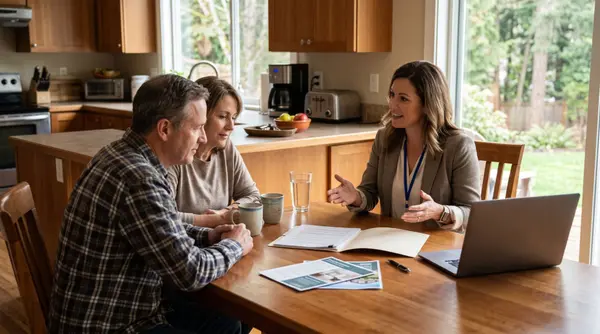
This is why a Comparative Market Analysis (CMA) prepared by a local agent is almost always more accurate than an online estimate — it combines real market data with human judgment and firsthand knowledge of your home and neighborhood.
How to Get an Accurate Picture of Your Home's Value
If you're seriously considering selling, refinancing, or simply want a realistic number, here's what we recommend:
- Use online estimates only as a loose starting point, not a final answer.
- Request a free Comparative Market Analysis from a local agent who knows your neighborhood.
- For lending or legal purposes, rely on a licensed appraiser's in-person valuation.
- Check current, active listings in your area to see what similar homes are asking today.
According to the National Association of Realtors, pricing strategy remains one of the biggest factors in how quickly — and how profitably — a home sells.
You can also review current trends through Realtor.com's local market data to see how estimates in your area compare to actual closed sales.
Curious how your specific home compares?
Take a look at our current listings to see what similar homes in your area are selling for, or read our related guide on
preparing your home for sale for more tips on maximizing your home's value before listing.
Recent Posts



GET MORE INFORMATION